
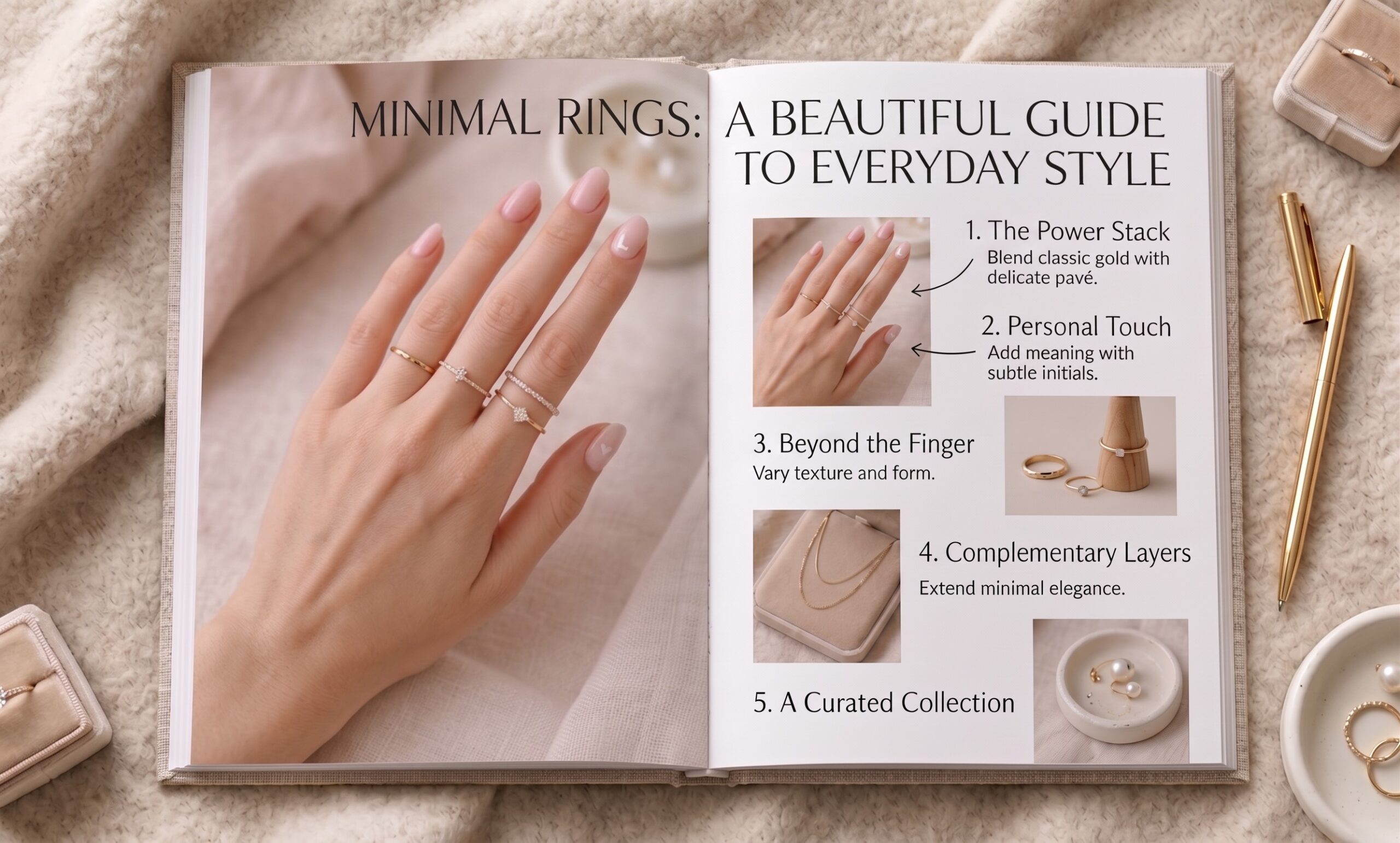
Minimal rings work best when they feel quiet on the hand and easy in daily life. A clean design is only the beginning. Fit, profile, material disclosure, maintenance, and the wearer’s routine decide whether a ring becomes a regular companion or stays in a drawer.
This guide focuses on practical choices rather than luxury labels. It explains how to compare simple bands, low-profile signets, subtle symbolic rings, and small stone settings without pretending that one metal or style suits everyone.
What Makes Minimal Rings Suitable for Everyday Wear?
Good minimal rings reduce unnecessary friction. They do not need to be invisible, but they should make sense with the wearer’s work, clothing, and tolerance for maintenance. A person who types all day may prefer a smooth band with softened edges. Someone who removes jewelry before exercise may be comfortable with a more sculptural profile.
The useful question is not “Which ring is strongest?” It is “Which combination of material, shape, and care fits this person’s actual week?” No ring is immune to wear. Scratches, patina, and small changes in finish are normal signs of contact with daily life.
Start With Fit and Profile
Ring size is only one part of comfort. Width, thickness, inner shape, and weight also change how a ring feels. Wider bands often feel tighter than narrow bands in the same nominal size. A rounded inner surface may slide over the knuckle more easily, while a flat interior can feel more stable on some hands.
Before buying, ask whether the seller provides exact width and thickness in millimeters. Product photos can make a ring appear lighter or heavier than it is. Measurements give you something concrete to compare.
- For frequent typing: consider a low profile with smooth outer edges.
- For stacking: check whether the sides sit flush against another band.
- For larger knuckles: ask about inner shape and exchange options.
- For a first ring: begin with moderate width rather than an extreme design.
Compare Materials Without Marketing Shortcuts
Material names should describe what the ring is actually made from. “Gold tone,” “silver color,” and similar phrases describe appearance, not composition. When comparing minimal rings, look for clear disclosure: solid metal, plated metal, vermeil, or another construction.
| Material | What to expect | Question to ask |
|---|---|---|
| Sterling silver | Can develop tarnish and surface marks; many owners value the changing patina. | Is the piece marked or documented as sterling silver? |
| Solid gold | Available in different karats and alloy colors; care needs vary with design and finish. | What karat and alloy color are disclosed? |
| Plated metal | The surface layer can change with friction, moisture, and use. | What is the base metal, and what care does the seller recommend? |
| Titanium or steel | Often chosen for a modern look; resizing options may be limited. | Can this exact ring be resized or exchanged? |
For formal definitions used in jewelry marketing, consult the FTC Jewelry Guides. They are a useful reference when a product description feels vague.
Choose a Finish You Can Live With
A mirror polish shows reflections clearly, but it also makes small surface marks easy to notice. Brushed and satin finishes diffuse light and can make ordinary wear less visually obvious. Hammered surfaces create more texture, although they are not automatically more durable.
Think about maintenance before choosing. If the wearer enjoys polishing jewelry, a bright finish may be satisfying. If they prefer a ring that changes gradually without frequent attention, a softer matte or oxidized finish may feel more natural.
Minimal Does Not Mean Meaningless
Simple rings can still carry strong private meaning. A narrow engraved line may represent a horizon. A tiny hourglass, skull, initial, or date can create a personal cue without dominating the design. The symbol should support the wearer’s intention rather than turn the piece into a slogan.
For readers interested in symbolism, our symbolic jewelry guide explains how to choose a motif with context. A subtle Memento Mori ring can also serve as a daily reminder when the wearer already connects with that idea.
Consider Stones and Settings Carefully
A small stone can still change the ring’s height and care needs. Low bezel and flush settings usually create a smoother outline than tall prongs. However, the right choice depends on the stone, the setting, and the wearer’s routine. Ask the seller how the stone is secured and whether the piece is intended for frequent wear.
Avoid assuming that “minimal” means maintenance-free. Delicate pavé, open settings, and very thin bands may require more attention than their light appearance suggests.
A Five-Minute Buying Checklist
- Confirm the ring size and the seller’s exchange policy.
- Check width, thickness, profile, and approximate weight.
- Read the material description for solid, plated, or mixed construction.
- Compare the finish with the wearer’s tolerance for visible marks.
- Review care instructions before engraving or customizing the piece.
- Delay permanent engraving until the fit has been confirmed.
This checklist is deliberately ordinary. That is its strength. Minimal rings succeed through proportion and repeat wear, not dramatic claims.
Care for Minimal Rings With Restraint
Use the seller’s care guidance because stones, coatings, and mixed materials can react differently. A soft dry cloth is a cautious starting point for many plain pieces. Remove rings before activities that could crush, bend, or deeply scratch them. If a ring contains a delicate stone or unknown finish, ask a qualified jeweler before using a chemical cleaner.
Our guide to cleaning jewelry while preserving patina offers a conservative approach for pieces whose surface character matters.
The Calm Choice
The best minimal rings are not necessarily the thinnest or most expensive. They are the pieces whose proportions, materials, and symbolism fit the person wearing them. Choose clear disclosure over vague luxury language, and choose comfort over a photograph that only looks good for a moment.
A simple ring earns meaning through repetition. When it fits well enough to join ordinary days, its quiet design has room to become personal.