
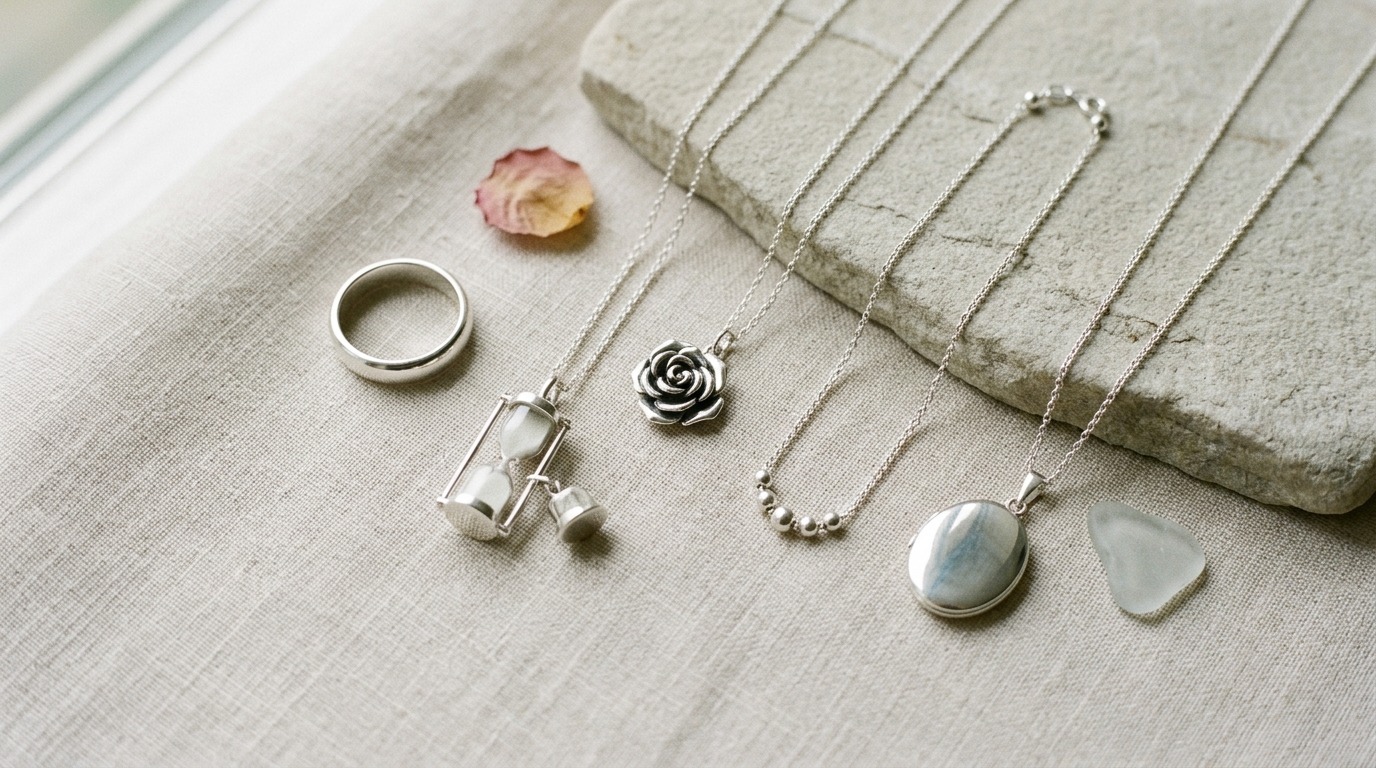
This symbolic jewelry guide is for choosing meaningful jewelry with taste, not for collecting dramatic motifs. The better question is not “what symbol looks interesting?” It is “what meaning should this piece carry, and can the wearer live with it comfortably?”
Symbolic jewelry can hold memory, identity, love, faith, philosophy, grief, courage, or a private daily reminder. It can be a ring, pendant, bracelet, signet, charm, or engraved band. The piece works best when the meaning, material, occasion, and lifestyle point in the same direction.

What Makes Jewelry Symbolic
Jewelry becomes symbolic when it carries a reason beyond decoration. That reason might be visible, like a skull, rose, cross, heart, hourglass, or initials. It might also be private, like an inner-band inscription, a birthstone, a material connected to a place, or a shape that only the wearer understands.
The symbol does not need to be complicated. In fact, quieter pieces often age better. A small pendant can hold memory without asking for attention. A signet ring can express identity without spelling everything out. A bracelet can work as a daily cue because it moves with the wrist and appears during ordinary routines.
That is the standard this symbolic jewelry guide uses: the piece should feel meaningful, wearable, and honest. If the jewelry needs a long speech to justify itself, the design may be trying too hard.
Choose Meaning Before Motif
Use this symbolic jewelry guide as a simple order of operations: start with meaning, then choose the motif. This keeps symbolic jewelry from becoming costume-like or trend-driven. A skull, rose, lock, eye, wing, candle, star, cross, snake, or inscription can all work, but each one changes tone depending on the reason behind it.
| Meaning first | Motif direction | Good jewelry example | What to avoid |
|---|---|---|---|
| Memory | Initials, dates, lockets, mourning-inspired details | Small pendant, engraved bracelet, signet with initials | Overly heavy wording that makes grief feel staged |
| Identity | Signet shape, crest, monogram, personal symbol | Clean signet ring or subtle pendant | Borrowed symbols with no personal connection |
| Philosophy | Latin phrase, hourglass, skull, minimal reminder mark | Engraved band or understated memento mori ring | Symbols that feel like a lecture |
| Gift | Birthstone, initials, simple motif, private inscription | Ring or bracelet chosen around the recipient’s routine | A symbol the giver likes more than the recipient does |
| Daily reminder | Small repeated cue, texture, phrase, wearable motif | Smooth ring, pendant, or bracelet that can be worn often | Uncomfortable pieces that stay in a box |
Symbol Types: Memory, Mortality, Love, Faith, Identity
Most symbolic jewelry falls into a few practical families. Memory jewelry keeps a person, place, date, or turning point close. Mortality symbols, including skulls, hourglasses, candles, and vanitas-inspired details, remind the wearer that time is limited. Love symbols can be romantic, familial, or memorial. Faith symbols can be devotional or cultural. Identity jewelry says something about belonging, name, heritage, taste, or personal discipline.
These categories can overlap. A skull ring may be mortality-focused, but it can also express identity or remembrance. A rose pendant may suggest love, beauty, grief, or impermanence depending on the design. A signet may be about family, self-definition, or simply a restrained way to wear a symbol every day.
For readers drawn to skulls specifically, the skull ring meaning page gives that motif more room. For the memento mori version of the same direction, the memento mori ring meaning guide explains how a ring can work as a daily reminder.
Ring vs Pendant vs Bracelet vs Signet
The form matters as much as the symbol. A ring is public because the hand is always moving. It appears while writing, working, greeting, paying, and gesturing. That makes rings strong for daily reminders, but it also means fit and comfort matter more than they do in a display photo.
A pendant sits closer to the chest and often feels more private or emotional. It can suit memory, love, faith, or a quiet symbol the wearer does not want on the hand. A bracelet is practical for repeated cues because it is felt throughout the day. A signet feels more formal and controlled, especially when the symbol is engraved rather than raised.
Here is the useful shortcut: choose a ring when the symbol should join daily action, choose a pendant when the meaning is more personal, choose a bracelet when the reminder should be subtle and physical, and choose a signet when identity or design restraint matters most.
Material and Finish Change the Mood
A symbolic jewelry guide should treat material as part of the message, not as an afterthought. Material changes the emotional temperature of the piece. Sterling silver often feels reflective, traditional, and adaptable. Stainless steel feels durable and modern. Gold brings warmth and ceremony. Oxidized finishes create contrast and make carved details easier to read. Matte finishes feel quieter, while high polish feels more formal and noticeable.
This is where a symbolic jewelry guide has to stay practical. A beautiful meaning will not fix a poor material choice. If the wearer works with their hands, a tall ring or delicate chain may not suit daily life. If the piece is a gift, a forgiving pendant or bracelet may be safer than guessing an exact ring size.
For metal tradeoffs, care, and daily wear, use the memento mori ring materials guide as a practical companion. Even when the page focuses on rings, the same questions apply: how the metal wears, how the finish ages, and how much maintenance the owner will actually accept.
When Symbolic Jewelry Becomes Too Literal
Symbolic jewelry becomes too literal when it explains itself too loudly. Too many motifs, oversized text, heavy slogans, and dramatic imagery can make the piece feel less personal, not more. Meaning gets weaker when every detail is shouting at once.
A good test is whether the piece still works with ordinary clothing. If it only makes sense with one outfit, one mood, or one staged photo, it may be more costume than companion. The most tasteful symbolic jewelry usually leaves a little room for interpretation.
- Avoid designs that combine every possible symbol in one piece.
- Avoid inscriptions that are too long to read naturally.
- Avoid gift jewelry that teaches the recipient a lesson.
- Avoid materials that look meaningful online but feel uncomfortable in use.
- Avoid claims about luck, protection, healing, or guaranteed transformation.
A Quiet Buying Framework
Use this symbolic jewelry guide framework before buying symbolic jewelry for yourself or someone else:
- Name the meaning in one plain sentence.
- Choose the form that fits the body: ring, pendant, bracelet, signet, or charm.
- Match the material to the routine, not only to the product photo.
- Check comfort, weight, edges, chain length, ring size, and closure quality.
- Ask whether the symbol will still feel right in six months.
- For gifts, start with the recipient’s taste and timing before the symbol.
- Choose restraint when the meaning is already emotionally strong.
If the piece passes those checks, it has a better chance of becoming something the wearer actually keeps close. If it fails one of them, the problem is usually not the symbol. It is the match between symbol, form, and life.
Best Next Pages by Reader Intent
This symbolic jewelry guide is a hub. The next page depends on what the reader is trying to decide.
| Reader intent | Best next page | Why it helps |
|---|---|---|
| I like skull jewelry but want the meaning first. | Skull ring meaning | Explains the motif without reducing it to shock style. |
| I want a ring as a mortality reminder. | Memento mori ring meaning | Connects the ring to daily attention and wearable symbolism. |
| I am choosing a gift. | Memento Mori gift meaning | Helps decide whether the symbol fits the recipient and the occasion. |
| I am comparing metals or finishes. | Memento Mori ring materials | Gives practical notes on silver, steel, gold, finish, and daily wear. |
| I want a more specific skull ring guide. | Memento Mori skull ring guide | Focuses on fit, comfort, material, and design details for skull rings. |
Final Takeaway
The best symbolic jewelry is not the piece with the loudest motif. It is the piece where meaning, form, material, and daily use agree with each other. Choose the meaning first, then let the object stay quiet enough to become part of real life.
That is the quiet promise of a useful symbolic jewelry guide: it helps the reader choose with more judgment and less pressure. A tasteful symbolic piece should not pressure the wearer or over-explain itself. It should feel chosen, not performed. That is the standard worth keeping.
Source Notes
- The Metropolitan Museum of Art provides useful art-historical context for still-life symbolism and vanitas objects: Still-Life Painting in Northern Europe, 1600-1800.
- The National Gallery’s note on Harmen Steenwyck’s Still Life: An Allegory of the Vanities of Human Life supports the mortality-symbol context behind skulls, watches, and temporary worldly objects: nationalgallery.org.uk.
- For gift-specific timing and emotional fit, use the site’s dedicated Memento Mori gift meaning guide rather than forcing every symbolic piece into one page.