
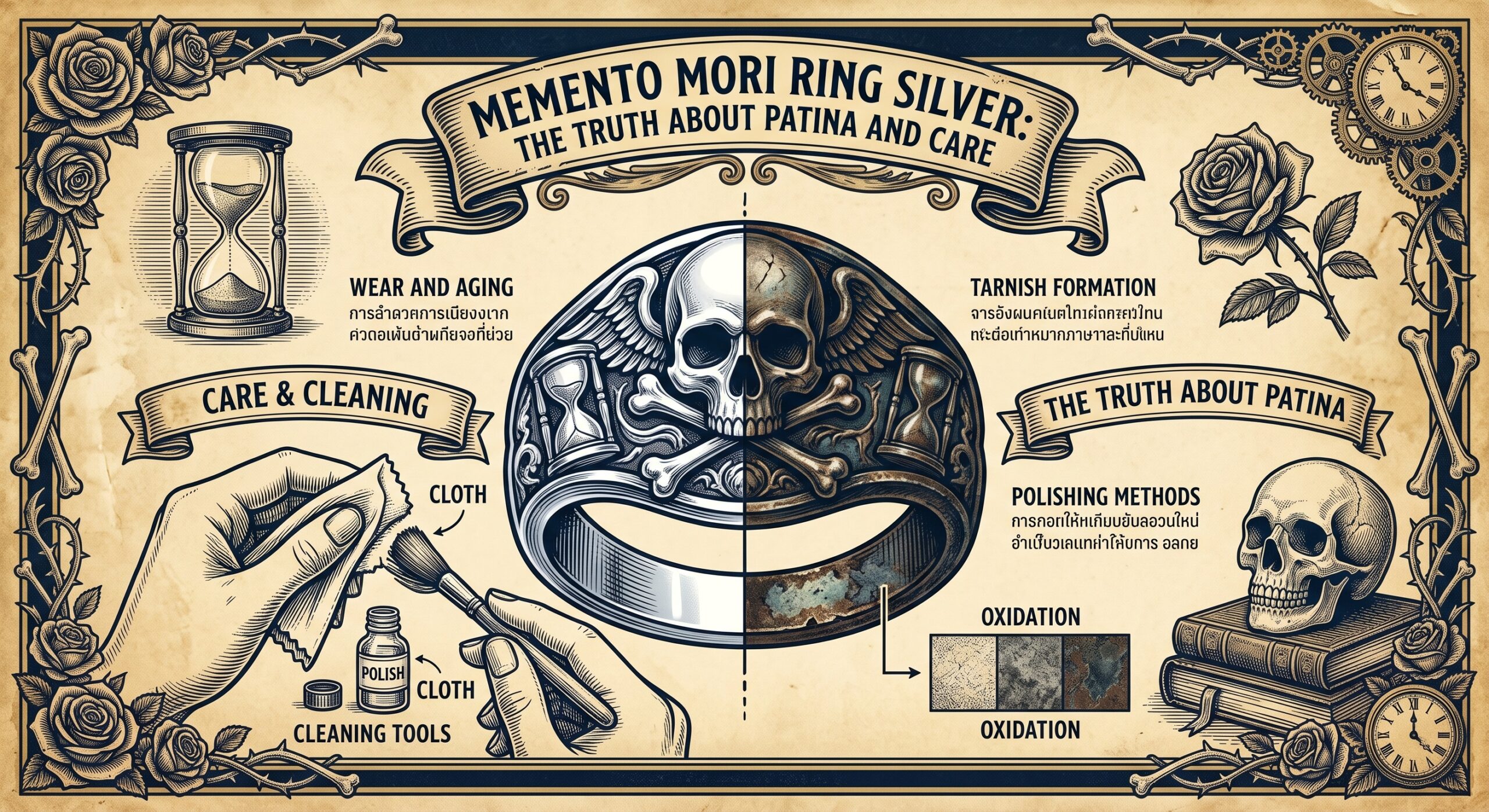
Buying a silver Memento Mori ring requires looking past the initial color in the display case. The metal’s exact composition, its hallmarks, the surface finish, and its history of previous polishing all dictate how the piece will age on your hand. Silver is historically favored for mortality jewelry for a specific visual reason: fine engraved lines can remain quiet and subtle in bright light, only revealing their true depth as the recessed areas naturally darken over time. That character is highly appealing, but it should never be blindly confused with proof of age or historical authenticity.
Before you purchase, polish, or attempt to restore a symbolic ring, you need to understand what jewelry marketing terms actually mean, how a patina develops chemically, and how to care for the piece without permanently destroying its fine details. For a broader framework on selecting these pieces, begin with our Memento Mori rings guide.
Decode the Metal Description First
Never buy a ring based purely on the word “silver.” According to the Federal Trade Commission (FTC), products legally described and sold as silver, sterling, or sterling silver in the United States must contain at least 92.5 percent pure silver. These pieces are typically stamped with “925” or “Sterling,” meaning 925 parts per thousand are pure silver, while the remaining 7.5 percent is usually copper added to give the soft metal necessary structural strength.
Be extremely careful with online terminology. Several similar-sounding terms describe vastly different, and often inferior, materials. If you are shopping, evaluate these descriptions closely:
- Sterling Silver / 925
- Contains 92.5% pure silver. Buyer’s check: Is the “925” stamp accompanied by a recognized maker’s mark or assay office hallmark, or is it just a generic stamp on a mass-produced band?
- Coin Silver
- Contains 90% silver. This is a historical standard heavily used in early American jewelry. Buyer’s check: Is this claim supported by a professional metal test, or is the seller just guessing based on the ring’s dull appearance?
- Silver Plate / Silver-Tone
- A microscopic layer of silver (or silver-colored alloy) applied over a cheap base metal like brass or copper. Buyer’s check: Avoid this entirely for a daily-wear Memento Mori ring. The plating will rub off on the edges within months, leaving a patchy, discolored surface.
- Oxidized / Antiqued Silver
- Solid silver that has been intentionally treated with chemicals (like liver of sulfur) at the jeweler’s bench to instantly turn the surface black. Buyer’s check: Understand that this dark finish is superficial. If you use harsh polishing cloths, you will accidentally strip the intentional shadow right off the ring.
Remember that a quality mark is useful evidence, but it is not absolute proof. Stamps can be worn away by time, forged by modern counterfeiters, or added long after the ring was actually made. For an expensive or supposedly antique piece, you must weigh the physical construction, provenance, and seller documentation alongside the stamp.
Why Silver Mechanically Suits Mortality Symbols
Silver offers a brilliant balance between visibility and restraint. If you engrave a skull into a highly polished, bright silver face, the image might only appear when the ambient light catches it at a specific angle. Darkened recesses, on the other hand, make that exact same image stark, graphic, and instantly readable from across a room. A satin or brushed finish lowers the overall contrast, allowing the physical, sculptural shape of the ring to do the talking rather than the shine.
None of these finishes is inherently more “philosophical” or authentic. The right surface is simply the one that allows you to read the symbol clearly without turning daily maintenance into an anxious chore.
Patina Is Not the Same as Dirt
Patina is a broad umbrella term used to describe the surface changes that develop through age, handling, and environmental chemistry. On silver jewelry, dark tarnish consists primarily of silver sulphide, which forms through natural exposure to sulphur-containing compounds in the air, in cosmetics, and even in your own sweat, according to the Canadian Conservation Institute.
On an older ring, this dark silver sulphide settles deep into engraved lines (like the eye sockets of a skull or the text of a Latin motto), while the exposed high points get rubbed bright by daily friction against your clothing. This natural contrast creates beautiful visual depth.
However, dirt, dead skin cells, lotion, and dried polish residue also collect in those exact same crevices. Visual appearance alone cannot always tell you what is valuable patina and what is simply grime. Furthermore, an evenly blackened ring is not automatically an antique. Modern makers frequently oxidize silver to imitate a century of age in about five minutes. Our authentic versus replica jewelry guide explains why surface appearance is only one small factor in authenticating historical pieces.
Inspect the Ring Before You Reach for Polish
Before touching a silver Memento Mori ring with any cloth or liquid polish, examine it closely under a soft, diffuse light (preferably with a jeweler’s loupe).
Look specifically for:
- Faded hallmarks, tiny date letters, or highly personal inner-band inscriptions.
- Faint seams that might reveal the ring is plated or made from composite parts.
- Traces of historical gilding, fragile black enamel, or filled recesses.
- Previous solder repairs, dangerously thin shanks, or loose stone settings.
This visual inspection dictates your next move entirely. Wiping down a modern, solid sterling band is a fundamentally different conservation project than handling a seventeenth-century mourning ring containing woven hair.
Clean for Stability, Not Maximum Brightness
The Canadian Conservation Institute explicitly warns that abrasive polishing and chemical tarnish removal strip away microscopic layers of the underlying silver. For museum objects, preventing tarnish is prioritized over polishing because repeated cleaning literally erases the surface details over time.
For a modern, plain sterling ring, always start with the least aggressive method possible. Remove surface dust with a dry, soft brush. If the ring can safely handle moisture, mild soap, warm water, and thorough drying are usually enough. Do not use water, and definitely do not use ultrasonic cleaners, on rings with porous stones, hair compartments, antique enamel, or sealed memorial cavities. Ultrasonic vibrations will shatter fragile historical materials.
Avoid these common maintenance shortcuts:
- Multi-purpose metal polishes: They are often far too abrasive for fine jewelry.
- Aggressive scrubbing: This will quickly soften and round out crisp engraved lines.
- Chemical liquid dips: These strip all oxidation instantly, leaving the ring looking sterile, flat, and unnaturally white. They can also ruin hollow rings if the liquid seeps inside.
When dealing with historically significant or delicate pieces, consult our guide to cleaning antique jewelry or speak to a professional conservator before attempting to remove any dark material.
Prevent Tarnish Before It Starts
Prevention preserves detail far better than polishing. The Canadian Conservation Institute recommends clean, dry storage, utilizing individual polyethylene bags for suitable objects, and keeping silver away from sulphur-releasing materials like rubber bands or certain paints.
For an everyday wear ring, you do not need museum-level climate control. Just build simple, practical habits:
- Wipe the ring with a clean, dry, non-abrasive cloth after wearing it to remove skin oils.
- Let all moisture evaporate completely before putting the ring inside a closed box.
- Store it separately so harder metals (like steel watches or diamond rings) do not aggressively scratch it in the drawer.
- Take it off before using household cleaning chemicals, applying heavy lotions, or swimming in chlorinated pools.
A Final Buyer’s Checklist
Before purchasing a silver Memento Mori piece, verify the following details to ensure the ring matches your lifestyle:
- The listing clearly and legally distinguishes between solid sterling, silver-tone, and plated base metals.
- Quality marks and maker’s stamps are clearly photographed in focus, not just vaguely mentioned in the product description.
- The seller transparently discloses whether the dark areas are natural historical tarnish or intentional chemical oxidation.
- Any mixed media elements (such as modern resin, antique enamel, or gemstones) are explicitly listed so you know how to clean them safely.
For older items, always review the Memento Mori ring antique guide before accepting a “925” stamp or a dark, moody finish as the final word on authenticity.
Final Perspective
The true appeal of silver mortality jewelry is its unique capacity to record its own history. The slightly brightened edges, the naturally darkened recesses, and the inevitable micro-scratches give the ring physical depth without diluting its philosophical purpose. Care for your ring in a way that preserves its legibility and structural integrity, rather than fighting a losing battle to force it back to a sterile, factory-new shine.