
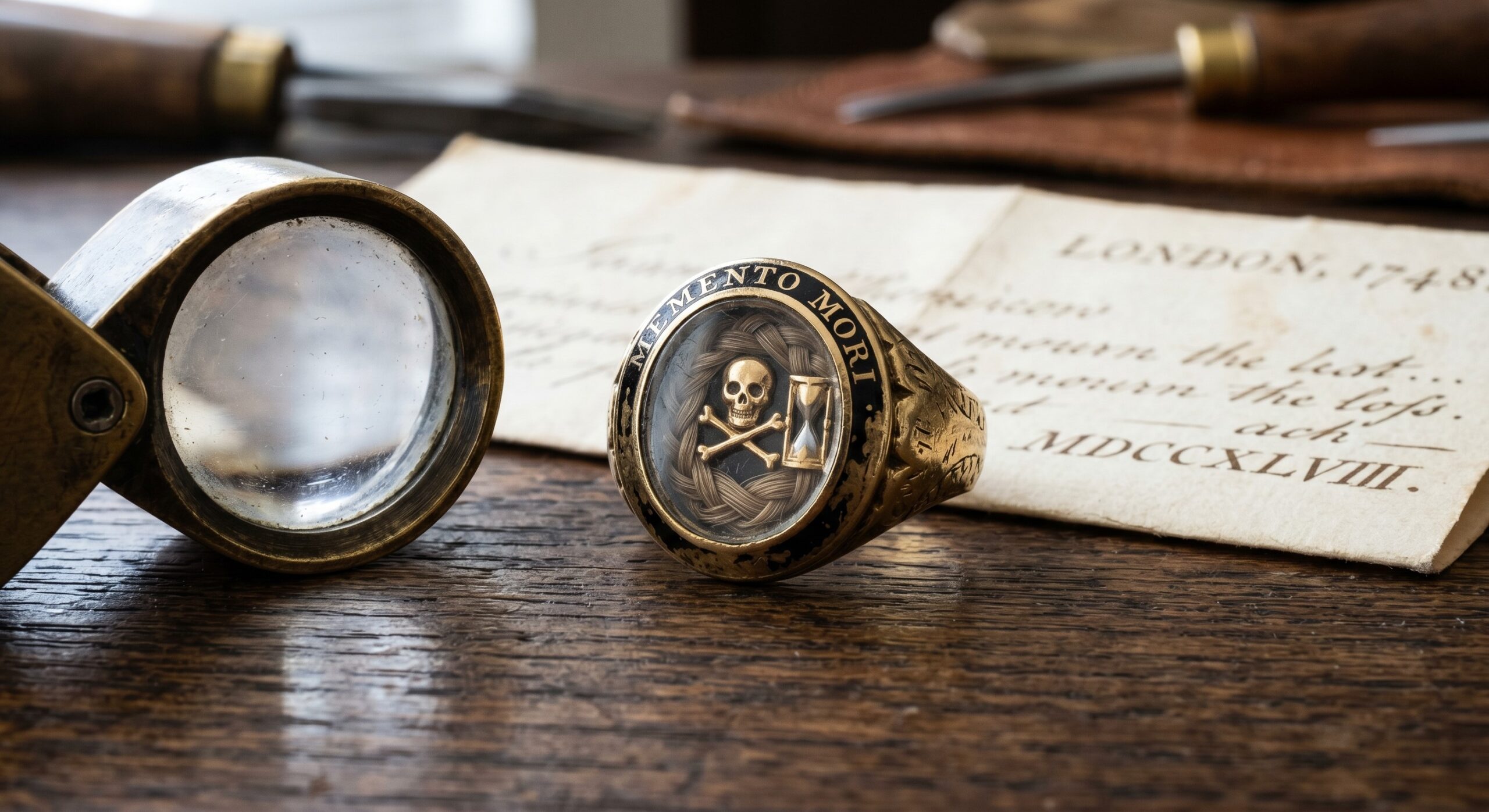
Whether you are pursuing a 17th-century heirloom or a high-quality reproduction, the distinction between a genuine artifact and a mass-produced imitation is vital. For collectors, the challenge lies in the sophistication of modern replicas, which are increasingly designed to bypass casual inspection.
This guide provides the tools to evaluate jewelry beyond the surface. We will examine the hallmarks of period-correct craftsmanship, how to identify modern casting methods, and what to look for when evaluating an antique memento mori ring. Our goal is to move you beyond “trusting the listing” and toward assessing the physical reality of the piece in front of you.

Defining Your Target: Antique, Revival, or Reproduction
Before evaluating a piece, it is crucial to categorize it correctly. Misunderstandings here are the primary cause of “buyer’s remorse” in the jewelry market.
- Authentic Antique: Created during a specific historical era (e.g., Georgian, Victorian, or Edwardian). These pieces exhibit original hand-forging, age-appropriate metal oxidation, and era-specific stone cuts.
- Period-Style/Revival: Jewelry manufactured in the 20th century that draws direct aesthetic inspiration from the 18th or 19th centuries. These can be valuable in their own right, but they are not “antiques.”
- Modern Replica: Mass-produced items, often created via CAD-designed molds. These are designed for aesthetic appeal, not historical significance.
When searching for an antique memento mori ring, the goal is to identify a piece that embodies the somber, symbolic tradition of the 17th–19th centuries, rather than a modern gothic-themed costume piece.
The Expert’s Eye: 5 Ways to Verify Authenticity
1. Assessing Construction Techniques
Modern, mass-produced rings are typically created through centrifugal casting. When a mold is pulled from a high-quality original, the detail is often “lost” in translation.
- Look for Porosity: Use a 10x jeweler’s loupe. If you see tiny, pinprick-sized holes (bubbles) in the metal, it is almost certainly a cast replica.
- Check the Under-Gallery: Authentic hand-made jewelry has intentional, crisp details in the under-bezel. If the area behind the gemstone looks “mushy,” smoothed over, or overly uniform, it is a hallmark of a quick-finish reproduction.
2. Metal Composition and Hallmarks
Period-appropriate materials are the most reliable indicators of age.
- Metal Purity: If you are looking at an “18th-century” ring made of white gold, walk away. White gold did not become a standard jewelry alloy until the early 20th century. Stick to yellow or rose gold, or sterling silver.
- The Hallmarking Trap: A lack of hallmarks can be normal for older, hand-forged pieces (which may have been hallmarked on the box, not the ring). However, if you see a modern laser-etched “925” or a generic, machine-stamped hallmark, the piece is modern.
3. Analyzing Gemstone Facets
Hand-cutting is inherently imperfect. If you are looking at an antique memento mori ring featuring rose-cut garnets or table-cut diamonds, the facets should not be identical.
- The “Perfect” Trap: Modern stones are cut by machines for maximum light return, resulting in mathematically perfect symmetry. If the stones in your ring are perfectly aligned and uniform in size, they are likely modern replacements or the piece itself is a reproduction.
4. Evaluating “Natural” Wear
True age cannot be perfectly replicated by a tumbler or chemical bath.
- Patina vs. Oxidation: Authentic silver or gold develops a multi-layered patina in the crevices that is difficult to fake. Beware of “spray-on” oxidation—if the dark areas look flat, one-dimensional, or appear to sit on top of the metal rather than within the pores, it is a synthetic aging process.
- Softened Geometry: An authentic 200-year-old ring will show “honest wear”—the edges of engravings will be smoothed by time and skin contact in a way that feels organic and asymmetrical.
5. Identifying “Marriages” and Modifications
Collectors often encounter “marriages,” where a genuine antique component (like a mourning locket face) is soldered onto a newer ring shank.
- Look for Solder Lines: Inspect the join between the setting and the band. A visible, messy, or dull-colored solder joint suggests that the piece has been modified. A piece that is truly “all original” will have a seamless integration.
Collector’s Comparison: What to Watch For
| Feature | Authentic Antique | Modern Replica |
| Metal Surface | Rich, complex, uneven patina | Artificial “distressed” look |
| Metal Quality | Period-correct (e.g., 15ct, silver) | Modern alloys/plated base metals |
| Gemstones | Hand-cut; slight irregularity | Machine-cut; uniform facets |
| Weight | Solid, consistent density | Hollow or unnaturally light |
| Documentation | Provenance/Expert assessment | None/Marketing-heavy description |
Avoiding Common Pitfalls
- The “Vintage-Style” Bait: Sellers often optimize listings for terms like antique memento mori ring, even when the description admits the item is a “vintage-style” reproduction. Always read the “materials” and “era” sections of the listing first.
- The Price Illusion: If the price is too good to be true, it is. Authentic historical jewelry is valued for its rarity. A high-quality antique memento mori ring is a finite resource; a replica is not.
- Transparency as a Test: Before buying, ask the seller: “Has this piece been altered, or is the setting original to the stone?” A reputable dealer will have an answer. If they are evasive, move on.
Frequently Asked Questions
How can I verify if a ring is truly “memento mori”?
Authentic memento mori pieces were created to serve as reminders of death. They often feature specific motifs like skulls, coffins, or hourglasses, and frequently include inscriptions in Latin like Memento Mori (Remember you must die) or Hodier Mihi, Cras Tibi (Today me, tomorrow thee). If the symbols appear purely decorative without historical weight, treat it as a “style” piece.
Is it ever okay to buy a “vintage-style” ring?
Absolutely. If you want the aesthetic of a vintage-style memento mori ring for daily wear, modern reproductions are a practical choice. They are more durable than fragile antiques and can be worn without the fear of destroying a piece of history. Just ensure you are paying for a reproduction, not an antique.
What is the best way to get a professional opinion?
Seek out an appraiser who is a Graduate Gemologist (G.G.) from the GIA and specializes in antique/period jewelry. Do not rely solely on a general jeweler, as they may have expertise in modern diamonds but not in 18th-century metallurgy.
Conclusion
The joy of collecting antique jewelry lies in the history the piece carries. While the market is flooded with high-quality vintage-style memento mori rings, the ability to distinguish these from authentic historical artifacts separates the casual buyer from the true collector. When in doubt, lean on professional appraisals and prioritize sellers who are as passionate about the item’s provenance as they are about the sale.