
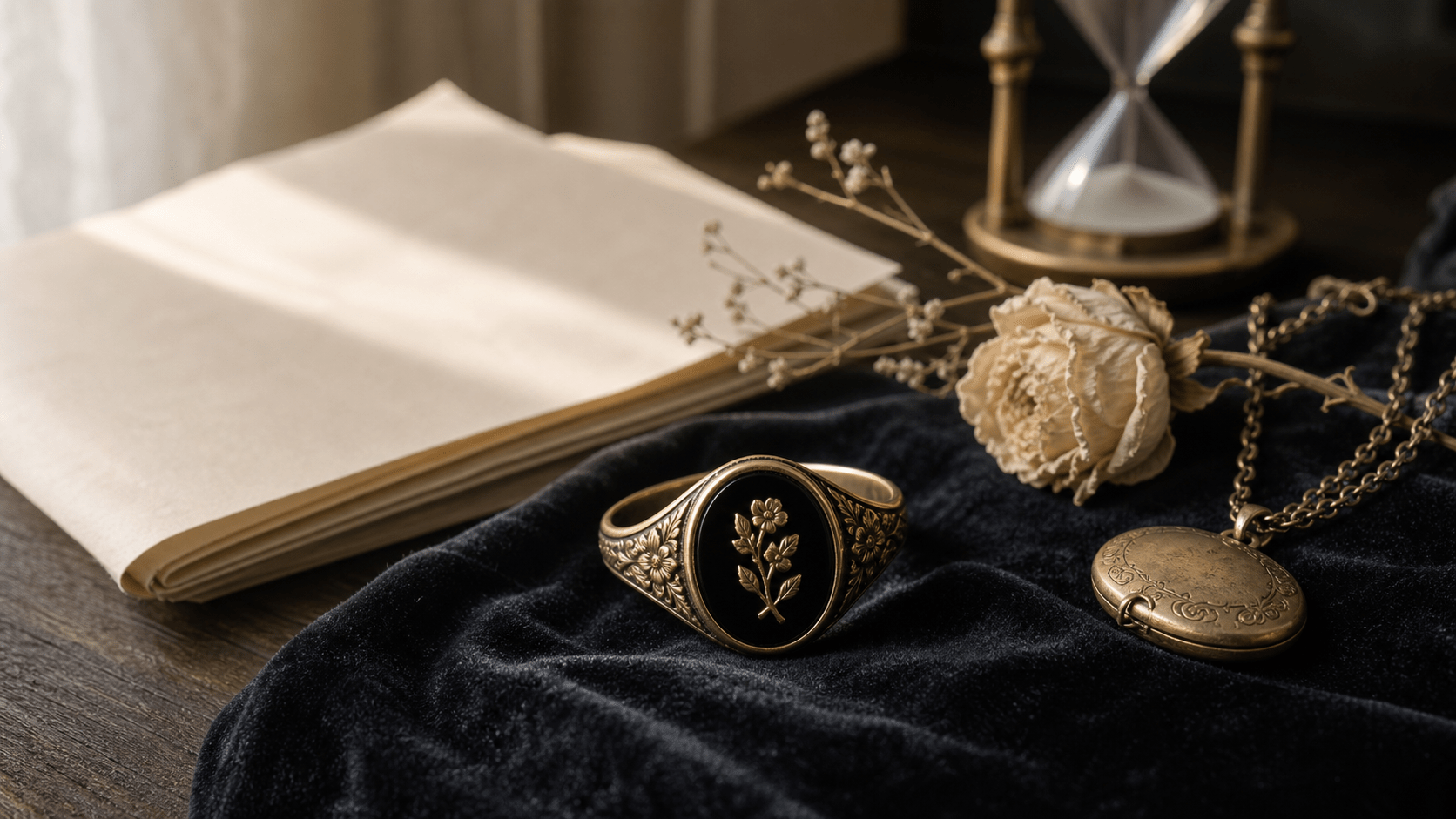
Mourning Rings vs. Memento Mori Rings: Understanding the Difference
Mourning ring jewelry remembers a specific person, while a Memento Mori ring points to mortality as a shared human condition. The traditions overlap, but their emotional purpose is not identical.
The two traditions frequently overlap in jewelry history because both deal with death, memory, and the passage of time. However, they do not carry exactly the same message. This distinction matters deeply whether you are cataloging antique jewelry, choosing a modern symbolic ring, or writing about memorial design.
The Core Distinction: One ring points toward personal loss. The other points toward a universal human condition.
A Person vs. A Truth
The easiest way to separate the two concepts is to look at the emotional and functional center of the object.
A mourning ring is tied to a life that has ended. It exists to keep a specific individual close to the living. It often includes identifying markers: a name, a date of death, initials, woven hair, or a dedicated phrase of remembrance. Its emotional weight is highly personal and often rooted in grief.
A Memento Mori ring is philosophical. The Latin phrase is commonly translated as “remember that you must die.” Symbols such as skulls and hourglasses can remind the wearer that time is limited. Unlike a mourning ring, it does not need to refer to a named person.
Anatomy of a Mourning Ring
A mourning ring is strictly memorial jewelry. It is commissioned, created, or worn after a death. Throughout history, particularly during the Georgian and Victorian eras, strict social protocols dictated how and when mourning jewelry should be worn. The physical details usually focus on preserving identity:
- Names and Inscriptions
- The initials of the deceased, often accompanied by phrases like “In Memory Of” or “Not Lost But Gone Before.”
- Specific Dates
- The exact date of death or the person’s age at the time of passing.
- Enamel Work
- Black enamel appears frequently in antique mourning jewelry, while white enamel appears in some pieces. Color alone cannot establish the wearer, date, or original purpose; provenance matters.
- Hairwork
- A prominent feature of Victorian rings, where the deceased’s hair was tightly braided under glass or woven directly into the band.
Not every mourning ring features all these details. Modern iterations might be as simple as a plain band with a hidden engraved coordinate. The defining rule remains: the ring carries a personal, specific memory.
Anatomy of a Memento Mori Ring
A Memento Mori ring works as a visual cue. Rather than looking only backward at a life that has ended, it asks the wearer to consider how they use the time they have. Common features include:
- Anatomical Symbols
- Skulls, crossbones, and full skeleton forms.
- Time Motifs
- Hourglasses, sundials, or the Ouroboros (a snake eating its own tail, symbolizing eternity).
- Nature Symbols
- Fading flowers or extinguished candles contrasting with the enduring metal.
- Mortality Inscriptions
- Latin phrases such as “Hodie mihi, cras tibi” (Today for me, tomorrow for thee) or simply “Memento Mori.”
Today, an entrepreneur, an artist, or a Stoic practitioner might wear one as a daily reminder to stop wasting time and to live with sharp intention because the clock is always ticking.
Where the Two Traditions Overlap
The line between mourning jewelry and Memento Mori jewelry is not always clean. During the 17th and early 18th centuries, the aesthetics of death were blunt. It was common to commission a mourning ring for a deceased parent that prominently featured a grimacing skull and crossbones. A ring from 1680 might feature a skeleton on the outside, but carry the specific name of a loved one on the inner band.
This overlap is why jewelry descriptions must be careful. Calling every skull ring a “mourning ring” is historically inaccurate, while labeling every antique memorial piece a “Memento Mori ring” flattens its grieving intent.
Quick Evaluation Guide
If you are examining a piece and need to categorize it, use this quick checklist to determine its primary function:
- Names & Dates: If it names a specific person and their exact death date, it is primarily a Mourning Ring.
- Physical Relics: If it contains woven hair or portrait miniatures, it is a Mourning Ring.
- Universal Symbols Only: If it only features a skull or hourglass without personal identifiers, it leans heavily toward a Memento Mori Ring.
- Primary Purpose: Ask yourself—is it built for personal remembrance (Mourning), or reflection on universal mortality (Memento Mori)?
Choosing the Right Language for Modern Wearers
If you are a jewelry designer, an antique dealer, or an affiliate marketer writing about these pieces, choose the language that matches the intention.
If the ring is designed to honor a lost partner, parent, or friend, use “mourning ring” or “memorial ring.” This language is respectful, clear, and honors the personal nature of the object.
If the ring is chosen as an aesthetic preference or a daily reminder to live with courage, “Memento Mori ring” is the accurate term. It stands on its own without needing a connection to personal tragedy.
Editorial Note on Product Descriptions
Avoid turning grief into an aggressive sales angle. Mourning jewelry should be described with restraint. Memento Mori jewelry, on the other hand, can be explained as fiercely reflective. However, keep the claims grounded. The strongest product language is often the simplest: frame the ring as a physical reminder, a timeless symbol, or a personal cue to live better.
Related Reading
- Skull Ring Meaning and Symbolism
- A Practical Guide to Symbolic Jewelry
- Candle Symbol Meaning in Art and Design
Source Notes
For object-level comparison, consult museum catalog records such as the British Museum collection search for mourning rings. Museum records help separate documented materials and inscriptions from modern marketing language.