
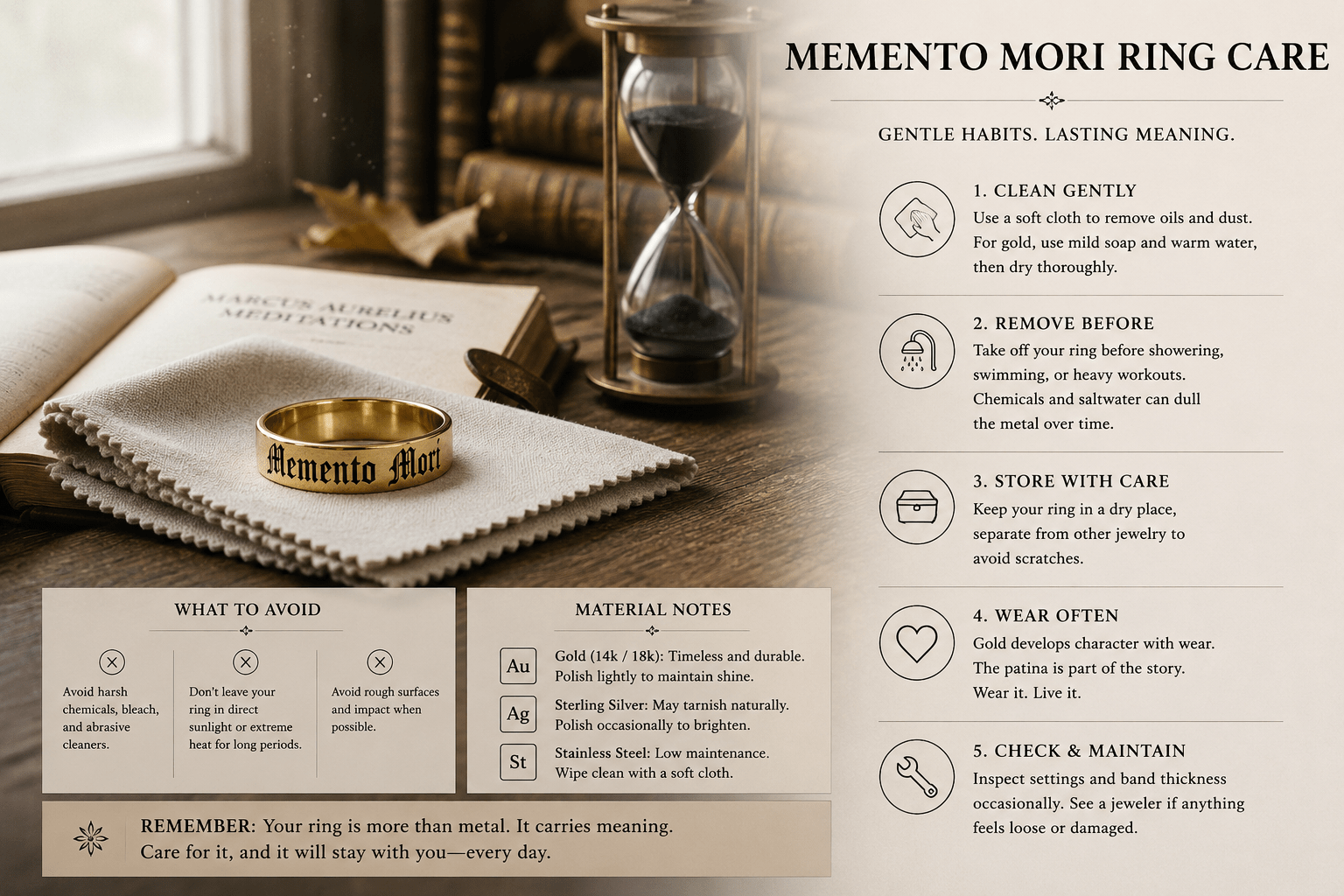
A skull on a ring does not tell you its whole story. An inscription, a memorial date, or the context in which it was made can change how the design should be read. Understanding memento mori ring meaning starts with the object itself, then leaves room for the person wearing it.
Memento mori means “remember you must die.” On a ring, that reminder may invite reflection on limited time, personal priorities, or faith. Those are possible readings, not a promise that wearing jewelry will change someone’s character. For the phrase beyond jewelry, see our guide to memento mori and its philosophical context.
Start with the Inscription
Look at the outside and inside of the band before assigning a meaning. Is there a motto, a name, a date, or a dedication? Copy the wording exactly, including unfamiliar spellings. A phrase about mortality and a dedication to a particular person answer different questions, even when both appear beside a skull.
The words MEMENTO MORI make the intended reminder more explicit than a skull alone. A name and date may point toward commemoration, but their significance still needs evidence. They could record a death, another event, or a later addition. If you are researching an older ring, compare the inscription with its collection record or documented provenance rather than guessing from its appearance.
A Museum Example Where Words Clarify the Image
The British Museum’s record for ring SL Rings.68 describes the inscription MEMENTO MORI surrounding a skull. Here, image and wording reinforce the same mortality reminder. The useful detail is their relationship: the inscription narrows how the skull can be interpreted.
This is a way to examine a ring, not a test of authenticity. A modern maker can reproduce an old motif or motto. Recognizing its message does not establish when the object was made, who owned it, or whether a seller’s attribution is correct. Those questions require separate evidence.
Symbols Need Context
A skull can serve as a mortality reminder, but it also appears in jewelry worn for personal style or cultural affiliation. You cannot infer the wearer’s beliefs from that motif alone. Gothic styling and philosophical meaning can coexist in the same piece.
Read details together. An hourglass beside a skull suggests a connection between mortality and passing time; a motto may make that reading more specific. A flower or a pair of wings is less conclusive without accompanying words or background. Avoid treating every decorative element as a code with one universal translation.
For a modern ring, a maker’s explanation can clarify the intended design, while the wearer may give it another personal meaning. For an older piece, distinguish what a museum or specialist documents from what you find evocative. “This reminds me of someone” is a personal response; “this was made to commemorate someone” is a historical claim.
When Remembrance and Mortality Overlap
Memento mori and mourning are useful distinctions, but they are not always separate boxes. One concerns mortality broadly; the other concerns remembrance of someone who has died. A single object can carry both ideas.
For example, the British Museum catalogues object 1961,1202.464 as a mourning ring. Its description includes a Latin inscription inside and memento mori wording on the exterior, alongside an hourglass and other decoration. The record shows why a mortality motto alone is not enough to exclude a memorial context.
When describing a ring, use the most specific account the evidence supports. If all you know is that it has a skull, say that. If a documented dedication identifies a person, include it. Our comparison of memento mori and mourning rings explores the distinction further.
The Wearer Adds Another Layer
A ring’s historical context and your reason for wearing it do not have to be identical. You might choose it to mark a personal commitment, remember someone, or simply because the design appeals to you. Be clear about which meaning comes from the object and which you bring to it.
An inner inscription can keep that meaning private. A prominent skull can make it visible. Neither choice is inherently more thoughtful, and an ornate ring is not less sincere than a plain band. Comfort and personal taste determine whether you enjoy wearing it; they do not measure the depth of your beliefs.
If you want to use the ring as a reminder, attach it to something specific: calling someone you keep postponing, pausing before an impatient reply, or making time for work you value. These are examples of intentions a wearer might choose, not effects a ring can guarantee.
A useful description separates three things: what is visibly on the ring, what reliable records tell you, and what it means to you. Keeping those distinctions clear lets personal meaning develop without inventing a history for the object.
Source Notes
The linked British Museum collection records support the two object descriptions above. The suggestions for examining a ring and choosing a personal reminder are editorial interpretation. Neither example is presented as a physical inspection or an appraisal.