
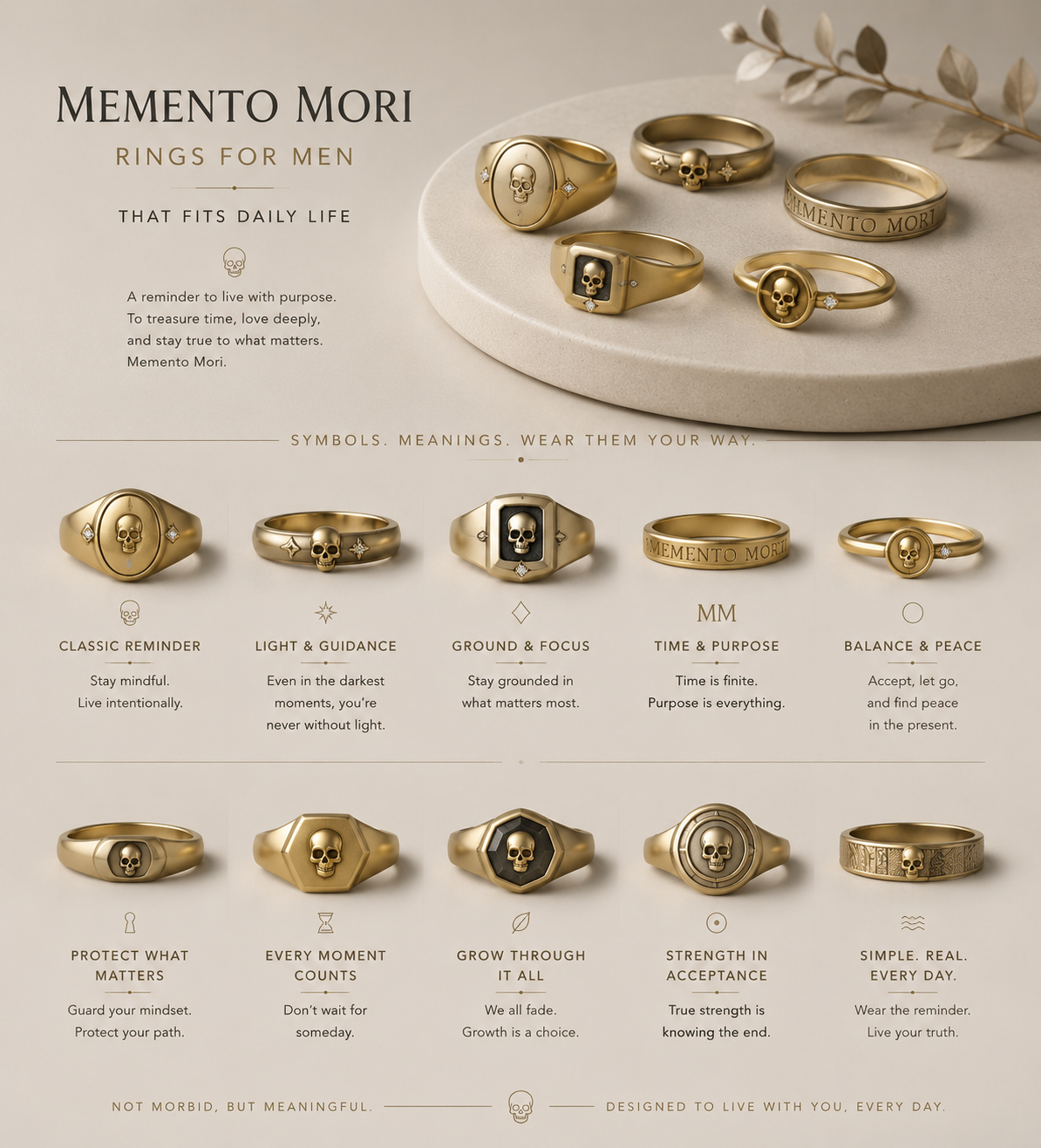
Choosing a Memento Mori Ring for Men
A memento mori ring for men should be chosen by the life it has to fit, not by an idea of how masculine jewelry is supposed to look. A compact signet can carry the same reminder as a sculpted skull. A plain band with an inscription can be more personal than either.
Start with four practical questions: what kind of reminder do you want, how visible should it be, where will you wear the ring, and what has the seller actually disclosed? Those answers narrow the choice more reliably than labels such as bold, gothic, rugged, or understated.
If the phrase itself is still unfamiliar, read what a memento mori ring means before comparing designs. This page takes up the next decision: choosing a ring that fits your hand, habits, and reason for wearing it.
What “For Men” Does Not Tell You
“Men’s ring” is a retail category, not a fit standard. It does not reveal how wide the band is, how high a signet sits, or whether a skull motif will feel natural on a particular hand. Those judgments depend on the construction of the ring and the preferences of the wearer.
Someone who rarely wears jewelry may prefer a low profile and a surface that is less likely to catch on a pocket or compete with a cuff. Someone looking for a visible symbol may accept more height and detail. The useful distinction is the amount of physical and visual presence you want from the reminder.
Choose the Form Before the Motif
A signet, a band, and a sculptural ring can behave differently even when they carry the same words or symbols.
A signet gives the design a clear face. It suits an inscription, seal-like emblem, hourglass, or restrained skull, but the face dimensions and profile height matter. If this form appeals to you, the memento mori signet ring guide explains the format in more detail.
A band can carry a repeating exterior motif, a restrained focal detail, or an inscription inside the ring. Ask whether lettering or relief changes the inner surface, because a front photograph may not show how that surface meets the finger.
A sculptural ring makes the motif the object. A skull or figure may have more projection, irregular edges, or weight concentrated above the finger. Do not infer comfort from the front photograph. Look for side views, face dimensions, band width, and total weight when the seller supplies them.
- Choose a low-profile band when the reminder is private and minimal projection matters.
- Choose a signet when a readable face, emblem, or inscription matters.
- Consider a sculptural design after confirming its profile, dimensions, weight, and side views.
A Ring Has to Clear the Knuckle
A ring can look properly proportioned and still be the wrong size. It must pass over the finger joint, then remain stable where it will be worn. The Gemological Institute of America’s quality-assurance guidance on finger and ring sizing says a correct fit should pass over the joint and settle at the intended position.
Width changes the measurement method. GIA distinguishes narrow rings from bands wider than four millimeters and recommends sizing gauges suited to the width. That matters here because a broad band and a narrow shank marked with the same nominal size may not feel alike.
If your knuckle is noticeably wider than the base of the finger, ask a jeweler to measure both areas and discuss the ring’s construction. A top-heavy design that is loose at the base may turn to the side, while a closer fit may be difficult to move over the joint. The sensible answer depends on the actual hand and ring, not a universal size adjustment.
Decide How Public the Reminder Should Be
Some rings announce the motif immediately. Others reveal it only when the wearer turns the hand. If the ring is a private cue, an inside inscription, narrow band, or small emblem may be enough. If it is meant to begin conversations, a signet face or recognizable motif gives other people something to notice.
A memorial intention may call for initials, a date, or a symbol connected to the person being remembered. Treat those details as personal choices, and confirm the design and inscription with the seller when personalization is offered.
Judge the scale beside the watch, cuffs, bracelets, and other rings you normally wear, if any. The guide to wearing a memento mori ring covers finger placement and visual balance.
Material Language Matters More Than Color
Silver-colored and gold-colored are appearances, not complete material descriptions. A seller calling an item a memento mori ring for men has not yet identified what it is made from. Check the stated material, the quality mark where applicable, and the company standing behind that mark.
The U.S. Federal Trade Commission’s consumer guidance for precious-metal jewelry explains common terms for gold, silver, platinum, plating, and vermeil. It also recommends checking the seller and obtaining the refund and return policies in writing.
Do not treat “silver tone” as equivalent to sterling silver. For gold-colored pieces, distinguish solid gold from gold plate, gold-filled material, and vermeil. These descriptions refer to different constructions. If a listing uses vague language without identifying the base metal or coating, carry that uncertainty into the buying decision instead of filling the gap yourself.
Material also changes the care question. Check the seller’s care instructions against the stated construction rather than assuming a metal will stay unchanged. For more detail about silver and surface change, continue to the memento mori silver ring guide.
Picture the Ordinary Day
Close-up photography can make almost any ring look easy to wear. Now picture the hand reaching into a pocket, passing through a shirt cuff, holding a steering wheel, or resting near a laptop. A high face, sharp projection, or broad band may be acceptable, but it should be a conscious tradeoff.
Remove rings wherever workplace rules or actual snagging, machinery, crushing, or electrical hazards require it. OSHA records include a ring-related snag injury; the applicable rule is the one for your workplace and task.
Outside those settings, look for interference that matters to you. Does the ring crowd adjacent fingers? Does it catch a cuff? Does its height make ordinary hand movements awkward? Product dimensions and a suitable return policy are more useful here than a dramatic product description.
Make the Seller Answer the Uncertainty
Before paying, look for information that lets you evaluate the object rather than the mood of the photography:
- Ring size and sizing method: Is the size stated in the system you use, and is there guidance for a wide band?
- Dimensions: Are the face width, profile height, and band width supplied?
- Material: Is the base metal identified? If the ring is plated or vermeil, is that stated clearly?
- Construction: Does the listing show side, interior, and underside views?
- Resizing: Can this construction be resized, and could resizing affect the finish or motif?
- Returns: Is there a written return or exchange policy for the size and customization you are considering?
- Personalization: If personalization is offered, can you confirm spelling, dates, placement, and symbol choice before production?
An antique or antique-style ring needs a different level of scrutiny. Age, maker, and authenticity cannot be established from a skull motif or darkened finish alone. Use the antique memento mori ring guide before treating a seller’s historical language as evidence.
Before choosing a memento mori ring for men, save only the listings that disclose sizing, dimensions, construction, material, and returns. Reject or question any listing that leaves a decision-critical detail unclear. Then compare the remaining options by form and by how visible you want the reminder to be.
If the choice still turns on symbolism rather than construction, return to the meaning guide. A seller can describe the object; the reason for wearing it remains yours.