
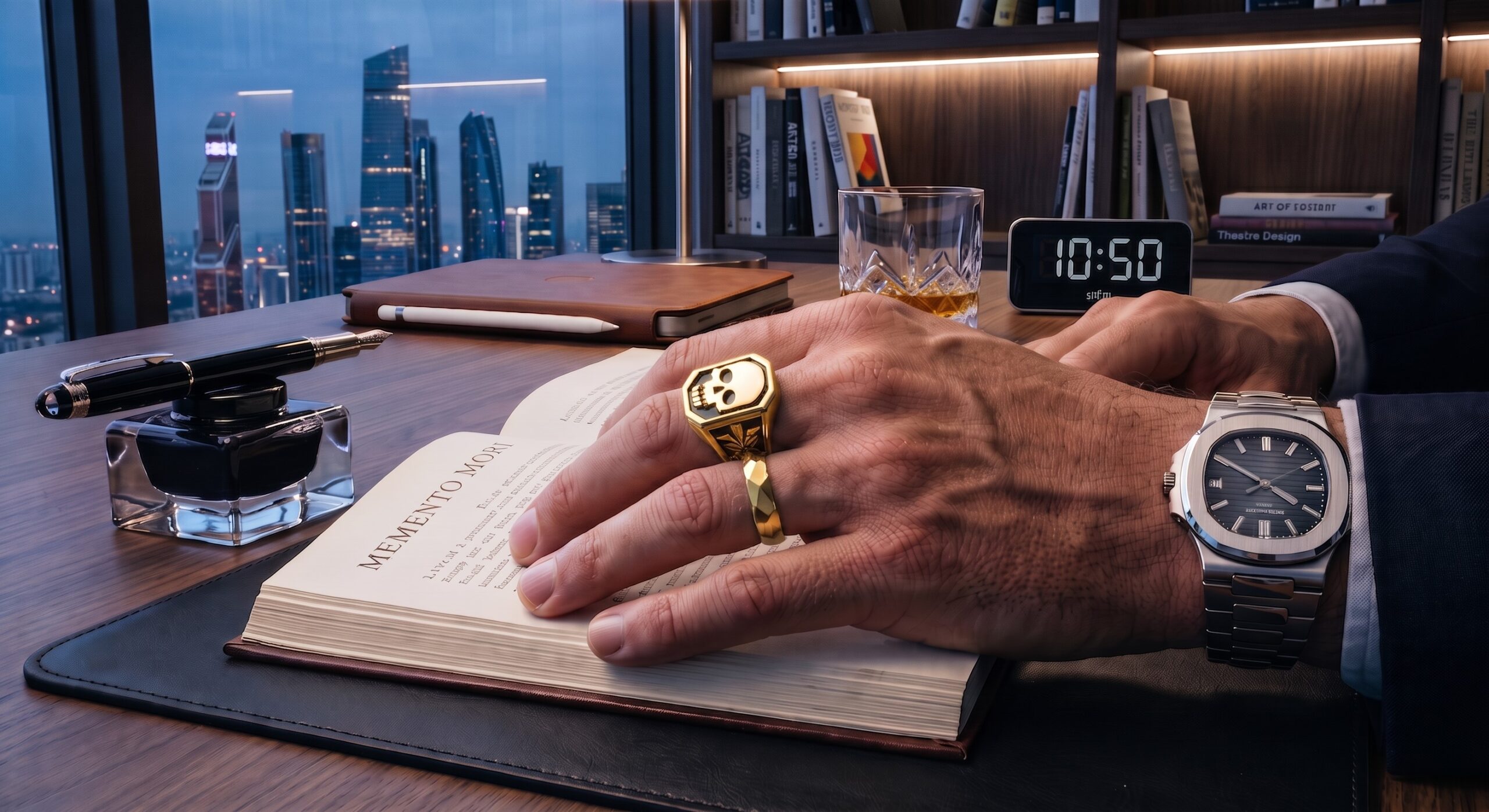
A Memento Mori ring for men should feel intentional, physically comfortable, and proportionate to the hand. It does not need to be oversized, aggressive, or covered in gothic decoration to carry weight. A low-profile signet, a simple band with a hidden inscription, or a restrained skull can all serve the exact same philosophical purpose: creating a visible, daily reminder that time is limited and your choices matter.
This guide bypasses marketing clichés and focuses entirely on how to choose a ring for real, everyday use. We will cover hand proportion, profile height, the reality of daily friction, metal behavior, and accurate sizing. For the historical and philosophical context behind these objects, begin by reading what a Memento Mori ring means.
For many men, this is the one ring they actually plan to wear, which means the choice has to work with a watch, a cuff, and a normal workday instead of only looking good in a product photo.
Start With the Wearer, Not a Stereotype
Men’s jewelry is routinely marketed through exhausted tropes of rebellion, raw strength, or “biker” status. These are terrible sizing tools and even worse substitutes for actual meaning. A Memento Mori ring is a psychological tool. It should suit the reality of the person wearing it, not a generic image of masculinity.
Before looking at designs, establish the baseline with four practical questions:
- What is the core intention? Are you looking for a private psychological cue, a visible conversation piece, or an aesthetic accessory?
- Where will it live? A ring worn in a corporate office, a mechanic’s garage, and a design studio face entirely different physical demands.
- What is your tolerance for physical presence? If you have never worn a ring before, a heavy, solid-cast skull will feel highly intrusive for the first few weeks.
- What is your maintenance reality? Do you want a ring that requires polishing, or one that you can ignore while it naturally heavily oxidizes and scratches?
The answers dictate the shape. A person typing on a laptop all day will quickly hate a ring with a tall, heavy projection that clanks against the aluminum keyboard. A person who works with their hands might need a minimal band that sits flush against the skin, or they may need to skip a ring entirely for safety.
The faster test is simple: if the ring clangs on a keyboard, fights a cuff, or feels crowded next to a watch, it is probably too much ring for everyday use.
The Anatomy of Fit: Beyond “Broad vs. Narrow”
Proportion is visual, but fit is structural. A common frustration for men is the “knuckle problem”—where the knuckle is significantly wider than the base of the finger. If you size the ring to pass the knuckle easily, it constantly spins at the base. If you size it for the base, taking it off becomes a painful struggle.
Instead of relying on absolute rules, use this framework to match the ring’s architecture to your hand:
- Narrow Fingers
- Focus on compact signets, medium-width bands, and motifs with clear negative space. Avoid massive, wide-faced signets; they will limit your finger’s lateral movement and constantly push against adjacent fingers.
- Broad or Fleshy Fingers
- Medium to large bezels feel visually balanced here. However, pay strict attention to profile height. A wide ring that sits flush to the skin is infinitely more comfortable than a smaller ring that projects aggressively upward.
- Prominent Knuckles
- Avoid extremely top-heavy designs. A heavy skull on a thin band will act like a pendulum, constantly swinging to the side of your finger. Look for rings with a “European shank” (a slightly squared bottom) or a wider band, which creates friction and stabilizes the top-heavy design.
These are the three setups that usually decide the outcome faster than any abstract rule:
| Situation | Better choice | Why it works |
|---|---|---|
| Office, laptop, and cuffs | Low-profile signet in silver or steel | It clears the cuff, stays quiet on the keyboard, and looks deliberate without needing extra rings. |
| Hands-on work or a busy commute | Plain band or very shallow symbol ring | It reduces snagging and is easy to wear all day without thinking about it. |
| Watch-heavy outfit | Matte silver, steel, or warm gold | It sits with the watch instead of fighting it and keeps the hand looking edited, not crowded. |
Pick the Format Before the Symbol
A Memento Mori ring for men generally falls into one of four distinct functional categories.
1. The Signet Ring
A signet places a flat or slightly domed canvas on top of the finger. It offers a highly readable face for an engraved skull, a winged hourglass, initials, or a specific date. Because the weight is distributed across a wider top surface, a well-made signet rarely snags on pockets or jacket sleeves. It is the most versatile format for daily wear.
2. The Symbolic Band
A band distributes metal weight perfectly evenly around the finger. This makes it exceptionally quiet and comfortable. The message might appear as a deeply engraved exterior pattern or a discreet interior inscription. Bands are the easiest format to pair with a watch or a wedding ring.
3. The Sculptural Skull
A fully three-dimensional, carved skull has immediate, undeniable presence. However, it requires scrutiny. Check the brow ridges, the cheekbones, and the jawline for sharp points. Aggressive carving will catch on knitwear, scratch screens, and collect dirt. Our skull ring meaning guide explains how these specific anatomical design choices fundamentally change the ring’s message.
4. The Inscribed Ring
Sometimes the strongest reminder is text. A heavy, plain band carrying a deeply engraved Latin phrase (like Amor Fati or Memento Mori) functions as a deeply private cue. It carries the philosophy without relying on gothic imagery.
Fit and Comfort Require a Real-World Test
Ring size is not just a circumference number. The width of the band, the shape of the interior edge, the weight of the metal, and your body temperature all drastically alter how a ring fits. The Gemological Institute of America (GIA) explicitly distinguishes between standard, wide, and convex-interior rings because they displace skin differently.
If you are investing in a substantial ring, do not rely on a piece of string or a printed paper chart. Use this routine:
- Measure your finger at the end of the day when your hands are slightly swollen, not first thing in the morning.
- If you are buying a wide band (anything over 6mm), you must be sized using a wide ring sizer. A thin sizing ring will give you a false, overly tight measurement.
- Make a tight fist. The bottom edge of the shank should not bite sharply into your palm.
- Confirm whether the design can actually be resized later. Rings with continuous patterns, deep side-engravings, or certain hard alloys often cannot be altered.
Choose Material by Reality, Not Status
Material dictates weight, maintenance, and durability. Choose your metal based on how hard you are on your hands.
Sterling Silver: The historical standard. It is relatively soft, meaning it will pick up scratches and dents over the years, creating a unique patina. It will tarnish, highlighting deep engravings beautifully. It is easy to repair and resize.
Gold (10k, 14k, 18k): Gold brings density and warmth. For a daily men’s ring, 10k or 14k gold is often preferred over 18k or 24k because the lower karat alloys are harder and more scratch-resistant. Gold feels significantly heavier than silver.
Steel and Titanium: Highly durable, incredibly rigid, and highly resistant to bending. However, this is a double-edged sword. If you injure your hand and it swells, emergency rooms have a much harder time cutting through a titanium band than a silver one.
Plated Finishes (Vermeil / Black Rhodium): Avoid these if you intend to wear the ring every day. No matter how well it is plated, the friction of your hand against steering wheels, door handles, and desks will rub the plating off the high edges within months, leaving a patchy finish.
For a no-drama daily ring, stainless steel is the easiest default. If you want the ring to age with you and develop soft tarnish, sterling silver is the better fit. If your watch, belt buckle, or cufflinks already run warm, 10k or 14k gold can make the ring feel deliberate rather than flashy. Titanium is the choice when weight matters most and you want the ring to disappear until you notice it.
Styling: Avoid the Costume Effect
The easiest way to integrate a symbolic ring is to let it stand alone. If you wear a heavy Memento Mori signet, you do not need three other rings and a stack of leather bracelets to accompany it. Let the object carry its own weight.
If you wear a steel dive watch, a silver or white gold ring creates a cohesive, utilitarian look. If you wear a leather-strapped dress watch, a warmer metal or a low-profile band integrates seamlessly. For specific advice on finger placement (index vs. pinky vs. ring finger), our guide to wearing a Memento Mori ring breaks down the visual impact of each placement.
Practical pairings are easy to picture: matte steel with a field watch and denim, silver with a button-down and no other rings, or low-profile gold with a blazer and a leather strap. Those combinations read like a decision, not a costume.
- Office day: one ring, one watch, low profile, nothing sharp.
- Weekend: a signet or band that can handle steering wheels, pockets, and movement.
- Workwear: plain band or no ring at all while tools are in hand.
A Final Buyer’s Checklist
Before purchasing a Memento Mori ring for men, run through this final audit:
- Purpose: Can you articulate why you are buying this specific symbol?
- Clearance: Does the profile sit low enough to comfortably reach into a tight jeans pocket?
- Stability: If it is top-heavy, is the band wide enough to prevent it from spinning?
- Watch pair: Does it sit naturally next to the watch you already wear most often?
- One-ring rule: If this is the only ring on the hand, does it still look complete on its own?
- Safety: Do you work around moving machinery? If yes, are you willing to take it off at work?
- Authenticity: If it is an antique, are you willing to treat it gently? (See the antique Memento Mori ring guide for verification steps).
- Disclosure: Are the materials clearly stated without misleading plating terminology?
The strongest choice is rarely the loudest one in the display case. A Memento Mori ring earns its meaning through years of daily, unnoticed friction. That repetition is only possible if the ring actually fits your hand, your habits, and your life.