
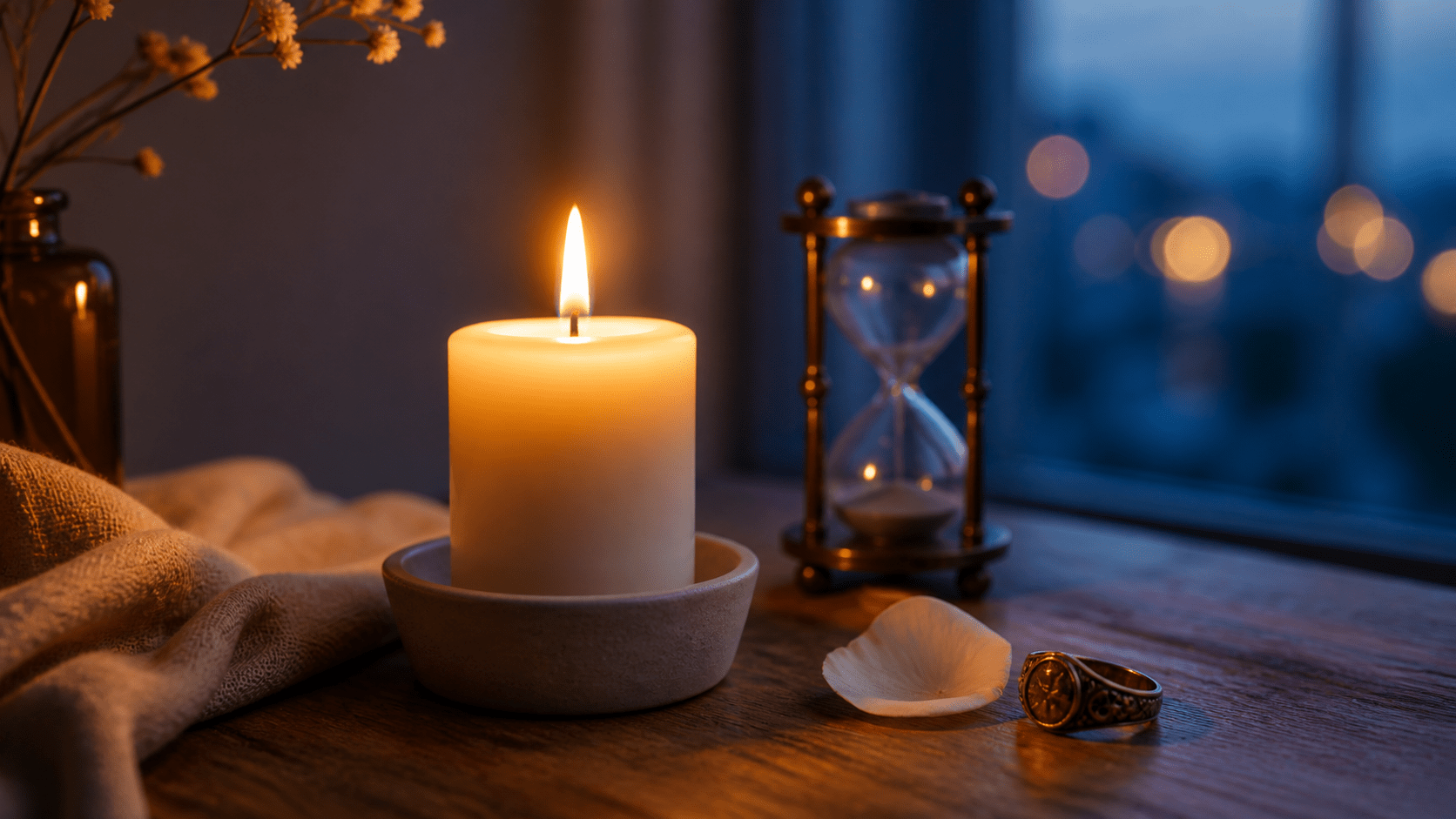
The candle symbol often represents life, time, memory, hope, and spiritual attention. In Memento Mori imagery, a candle is one of the most accurate reflections of the human condition: it burns brightly for a while, remains highly vulnerable to its environment, and is ultimately consumed by the very energy that gives it light.
A candle is a relatively small, ordinary object, yet it carries a massive conceptual weight. It provides illumination, but the cost of that light is its own disappearance. That inherent tension—the simultaneous act of living and dying—is exactly why the candle has dominated memorial art, religious spaces, still-life paintings, personal rituals, and symbolic jewelry for centuries. It does not just represent death; it represents the precise mechanics of living.
The Anatomy of a Consumable Metaphor
To understand why the candle works so well as a symbol, you have to look at how it actually functions. A candle is entirely finite. Unlike the sun or the stars, which feel permanent to the human eye, a candle’s lifespan is visible and measurable.
The wax represents the physical body—the fuel or the allotted time a person is given. The wick acts as the conduit, the mechanism of action. The flame is the life force, the consciousness, or the soul. From the moment the wick is struck, the object begins to destroy itself in exchange for producing light and heat.
The simplest reading of a candle is temporary light. It does not shine forever, and it was never designed to. Its beauty and utility come specifically from the fact that it is active and passing at the exact same moment. This makes it a deeply empathetic mortality symbol. While a skull confronts the viewer with the harsh reality of bone and finality, a candle speaks through atmosphere and warmth. It suggests presence, guidance, and the briefness of life without ever needing to be graphic or terrifying.
The Vulnerability of the Flame
The flame is the living, breathing part of the symbol. It is not static. It moves, dances, and reacts instantly to the air around it. It can be cupped and protected, weakened by a draft, or snuffed out completely in a fraction of a second.
Because of this physical reality, candle symbolism heavily emphasizes vulnerability. It carries the distinct feeling that something precious requires active care to survive. It mirrors how easily a human life, a relationship, or a specific period in time can be disrupted.
The state of the flame changes the meaning completely. A steady, upright flame suggests quiet devotion, unbroken awareness, or a soul securely held in memory. A flickering or fading flame suggests exhaustion, illness, the harsh passage of time, or an ending drawing near. A newly lit candle feels completely different—it suggests a deliberate beginning, a renewed intention, or the sudden spark of an idea.
The Candle in the Vanitas Tradition
In classical Memento Mori and Vanitas art, the candle rarely sits alone. It belongs to a specific family of time-keeping symbols. You will often see it positioned near an hourglass, a skull, an open book, a wilting flower, or an overturned cup. Each of these objects points toward impermanence, but from entirely different psychological angles.
The candle is particularly vital in these arrangements because it introduces motion into an otherwise still image. A skull shows what remains after death. An open book shows human knowledge that will eventually be forgotten. But a burning candle shows that time is currently being spent. It proves that the present moment is alive and actively slipping away.
A burning candle in a painting carries a very specific, undeniable message: this exact moment will not remain as it is. For an excellent art-historical example of how this symbolism functions alongside other objects, look at the National Gallery’s analysis of Harmen Steenwyck’s vanitas painting, where the mechanics of light and shadow dictate the entire meaning of the canvas.
Candle, Hourglass, and Skull: A Distinction
While all three objects remind us of death, their emotional temperatures differ significantly. A person choosing a motif for a ring, a tattoo, or a piece of art must consider what tone they actually want to carry.
| Symbol | Main idea | Emotional tone |
|---|---|---|
| Candle | Life as fragile light and actively passing time. | Quiet, warm, empathetic, reflective. |
| Hourglass | Time moving steadily in one visible, undeniable direction. | Measured, disciplined, cold, philosophical. |
| Skull | The absolute, shared end of human life. | Direct, bold, unmistakable, confrontational. |
These meanings overlap, but they are not interchangeable. You do not use a skull when you want to convey hope, just as you do not use a candle when you want to communicate rigid discipline.
The Active Role of Candles in Grief
There is a reason candles are heavily integrated into grieving practices across almost every major culture. Grief is often an invisible, internal experience. Lighting a candle creates a visible, physical act of attention. It proves that something abstract—a memory, a lost person, a tragedy—is being actively held in the mind.
Lighting a candle gives memory a temporary physical form. It provides a focal point for a person who may not have the words to explain their loss. The candle feels appropriate in these settings because it does not attempt to explain death, nor does it offer empty platitudes. It simply makes a quiet space for presence, silence, and respect until the flame burns out naturally.
Choosing the Symbol for Jewelry and Design
In the context of symbolic jewelry, the candle is often the choice of the introvert. It is a much softer, more private alternative to wearing a skull or a scythe. A candle engraved on a signet ring or worn as a small pendant acts as a personal anchor.
It represents inner light, the intention to live deliberately, or the quiet remembrance of a specific person. It works perfectly for individuals who want a daily Memento Mori reminder without adopting the heavy, gothic visual style that often accompanies mortality-themed accessories. It remains readable only to the wearer and to those who understand the nuance of the symbol.
Avoiding Solemnity in Daily Use
While the candle is deeply tied to death, it becomes suffocating if every use is treated as a heavy memorial. Balance is necessary. A candle also represents the warmth of a lived life. It suggests the quiet focus of studying late into the night, the patience required to see a difficult task through, or the simple comfort of sitting in a quiet room at the end of a long day.
For anyone practicing Memento Mori, this dual nature is highly useful. The candle bridges the gap between acknowledging death and actually enjoying ordinary life. It reminds you that because the wax is melting, you should probably pay attention to the light it gives off right now.
A Quick Guide to Variations in Candle Imagery
The context and condition of the candle change its message immediately. If you are reading a piece of art or choosing a design, consider these distinctions:
- A bright, steady candle: Life in its prime, deep presence, active prayer, unbroken awareness, or enduring hope.
- A candle burning down to the base: The reality of passing time, advancing age, limited energy, or the nearing of an inevitable end.
- An extinguished or smoking candle: A sudden ending, absence, deep remembrance, or the absolute completion of a task or life.
- A candle placed beside a skull: The ultimate Vanitas pairing—life (the flame) and death (the bone) held in tension within the exact same frame.
- A candle placed beside an open book: The pursuit of knowledge, late-night study, wisdom, and the sobering reality that we do not have enough time to learn everything.